Wednesday, October 28, 2009

3 Iron (Korean: Bin Jip)


Movie: 3 Iron


Year: 2004


Director: Kim Ki-duk


Language: Korean


Synopsis:Tae Suk is a drifter on a bike and goes around dropping take out menus to different people across the city. Later in the night when he returns to find that some menus have not been taken he breaks open into these houses and stays there. He doesn’t enter these with the motive of burglary but uses it as his home. He takes care of the house. Cleans the house, repairs the instruments and quietly vanishes before the owners are back. In one of these attempts he comes across a battered wife of a rich guy, Sun Wha. Sun Wha who is assaulted and injured many times doesn’t say anything when Tae Suk breaks into her house. She hides and observes him from a distance till the point when he realizes that she had seen him all along. Tae Suk leaves and returns after much contemplation. He finds Sun Wha being abused by her husband. He hits the husband using golf balls and they elope. Both of them start living in apartments they break into. After a mixed bag of events they get caught in an apartment where an old man had died. Tae Suk is arrested and sentenced. In jail he practices becoming a shadow which allows him to be invisible because he is always at 180 degrees behind the person in front. He goes back to Sun Wha, only this time her husband is not able to see him in the house. Very weird


My own take: It takes you sometime before you realize that the two main characters in the movie have no dialogue at all. The story is told only by the supporting cast who speak. The strength of the movie comes also from the fact that they have used the actors to convey their feelings only through actions, so it leaves a lot to the imagination of the viewers. Watch the movie for the cinematic experience and also for the different story. Couple of scenes are very different and leave a mark. For example one of my favorite scenes is one in which Tae Suk goes into a photographers house and reorganizes a picture to add his artistic bit. Typical Kim Ki-duk kind of direction which has a lot of symbolism. Evening after office type watch

Wednesday, October 14, 2009

Rashomon (Japanese)


Movie: Rashomon


Year: 1950


Director: Akira Kurosawa


Language: Japanese


Synopsis:There are couple of things which are as timeless as this movie. The plot revolves around the rape of a woman and the murder of her husband, a samurai, by a bandit in the forest. There are five witnesses to this incident and they come to testify in the court. There is a monk, a woodcutter, the bandit, the wife and the samurai who comes via a medium. The story revolves around how all these people have a different view of the same incident and everyone adds his/her own perception to the thing. This adds to the problems as most people are also trying to explain the incident from their own view points to save themselves. The complex plot leads us into very significant questions on honor, trust, desire, lust and pride.


My own take: Few classics in the cinematic world achieve such rare levels of cult status. This movie has not just inspired many movies, series and plays but also finds mention in literature. The beauty of the movie comes from the way how everybody’s truth and lies differ. The truth is never found eventually because the truth is all dependent on the individuals and all of them are convicts in some way or the other. The guilt in each individual as well as the attempt to save themselves determines the stories. The movie actually throws up a very important question that if the essential data is kept intact the interpretation is completely dependent on the stakeholders. A masterpiece that has been around for over 50 years and even today anyone watching world movies will find it extremely enjoyable. Must watch

Friday, September 25, 2009

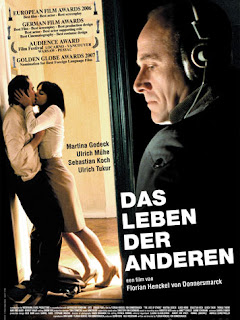
The Lives of Others (German: Das Leben der Anderen)


Movie: The Lives of Others


Year: 2006


Director: Florian Henckel von Donnersmarck


Language: German


Synopsis:The drama is set in 1984 in East Germany. We are introduced to Wiesler who is an interrogator at the Stasi and is known to be really good in his work. In his personal life he is a loner and a favorite of Grubitz who is his friend and superior. Grubitz wants Wiesler to spy on playwright Georg Dreyman, who is suspected of pro-Western sympathies. Stasi agents secretly enter Dreyman's flat, install small microphones and then monitor activity from the attic space above. Wiesler believes in the cause of the government completely and hence has unparalleled loyalty to the cause. However very soon he finds that the real reason behind the surveillance is that a minister named Hempf desires Dreyman's girlfriend, actress Christa-Maria Sieland. Dreyman's arrest would rid Hempf of a rival. Wiesler, a true believer in the socialist regime, is disillusioned by a minister abusing his powers for personal interests. Christa- Maria on the other hand sees Hempf secretly as she is scared to turn down such a powerful person. Wiesler who secretly doesn’t like the way dissidents are treated and feels that they deserve some compassion secretly arranges a Dreyman and Maria confrontation to clear the air. As they confront one of Dreyman’s friend commits suicide. This finally spurs Dreyman into speaking out against the regime. He arranges to anonymously publish an article on carefully concealed suicide rates in the GDR in the West German magazine Der Spiegel. Because all typewriters are registered, Dreyman uses a typewriter smuggled in from the West with a red ribbon to write the article, which he hides under the threshold between two rooms of his apartment. Before discussing sensitive issues in the flat, Dreyman and his friends try to test whether the flat is bugged by a feigned attempt at smuggling. However, out of compassion, Wiesler fails to pass on the information, making the conspirators think that the flat is not bugged. Though Wiesler intended his inactivity to be a one-time move, his compassion for the couple grows and he continues to lie in his reports to protect Dreyman, and also reduces surveillance hours, so that he no longer has to share the work with an assistant, who will not try to protect them. The story progresses all the way till unification of the Germanies and finally ends in Dreyman learning from Hempf that he was under full surveillance probing into his Stasi file, he finds out that, while agent "HGW XX/7" had heard Dreyman's activity against the regime he had prevented Dreyman from being found out. At the final page, a smudge of red ink reveals the agent's contact with the hidden typewriter. Dreyman succeeds in locating Wiesler, and he watches for a few minutes from a distance as Wiesler goes about his new job delivering advertising leaflets. Two years later, Dreyman publishes a novel, “Sonata for a Good Man” dedicated "To HGW XX/7, with gratitude".


My own take: The movie won the Best Foreign Language Movie in 2007 Academy Awards and definitely deserves this. The beauty of the movie is the internal strife that Wiesler goes through when he starts this particular assignment. I had read a story long back about a Japanese interrogator who was a loner because he could look through people. And the story told about how his talent was his curse. Wiesler strongly reminds me of that character. The reason he feels so strongly for this couple suddenly even after doing so many successful assignments is because he realizes somewhere in between, that he is spying on two individuals who are not a threat as is made to believe. And his actions that follow which make him go through a series of terrible events but make him hold on to his values. Sometimes I get a feeling that maybe he is trying to atone for his guilt of the past or maybe his emotions let him to believe that if he can get it right just this one time maybe he will be forgive himself? The movie is a sensitive portrayal of the relationship between Dreyman and Maria and is beautiful in parts. Not a light watch and will leave you with some points to ponder. The last shot where both the characters acknowledge each other is very unique.

Tuesday, September 1, 2009

Il Postino (Italian)


Movie: Il Postino


Year: 1994


Director: Michael Radford


Language: Italian


Synopsis:In a small village in coastal Italy Mario, the son of a fisherman, takes the job of a postman. His only work is to deliver letters to Pablo Neruda the famous Chilean poet who is staying on that island on exile. Neruda has been exiled to Italy due to his communist views. Slowly the movie explores the development of a friendship between Neruda and Mario. Mario develops a love for poetry and helped by Neruda starts using his new found communication skills to woo the lady of his dreams, Beatrice. Almost at the same time both Mario and Beatrice get married and Pablo leaves Italy for his country. Years later Pablo revisits the village to find out that Beatrice in the same café along with her son. She hands him a sound recording that Mario had made for Pablo of various sounds of his life…and it leads to the sound of his being killed while trying to get on stage to read a poem of Pablo.


My own take: The best description of this movie is poetry brought to life. The movie is so beautiful that it builds its story around the scenery and characters in one fluid motion. The character of Mario is so lovable that it touches your heart in many ways. You empathize with him when he struggles to get his love or when he seeks advice from the elderly poet. The director manages to bring smiles when Mario tries to get the love of his life. And then the emotions change when the pain of separation makes Mario do things to get back the friendship he had with Pablo. The last scenes when Pablo gets the tape which capture the sounds that Mario wanted the poet to hear are heart wrenching. Trivia about the movie- Massimo Troisi the postman in the movie actually died of a heart attack about 12 hours after the last shot of the movie. He was postponing his surgery for the movie. Must watch if you dont want to miss out a serious classic.

Tuesday, August 25, 2009

Spring, Summer, Fall, Winter... and Spring (Korean: Bom yeoreum gaeul gyeoul geurigo bom)


Movie: Spring, Summer, Fall, Winter... and Spring


Year: 2003


Director: Kim Ki-duk


Language: Korean


Synopsis:The movie begins in a small lake inside a forest that has a floating monastery. The monk and his young apprentice spend time going into the forest and collecting herbs and praying. The young monk one day finds it amusing to tie rocks to a fish, a frog and a snake. The teacher seeing this ties a rock to the apprentice and tells him that he shall free him from the torment only after he frees the other animals. He also tells him that if any one of them is dead he will carry the stone in his heart for the rest of his life. Years later there is a young lady who comes to the monastery to cure herself of a strange disease. The young monk slowly explores the feelings of love and experiments with his feelings. As events unfold his life is told in seasons which are set many years apart. The story moves from his running away from the monastery to finally coming back years later and then finally taking over as the caretaker of the monastery with a new apprentice.

My own take: If I had to put a genre to this movie I would be really in a fix. So lets just call it a really thought provoking movie. The beauty of the movie is in the small one liners which will sum up the seasons like the crux of the matter. And that is what makes you think again and again about the movie. These pearls of wisdom actually make the movie so rich in parts that you tend to forgive the guy who was writing the subtitles for missing out couple of lines . As I saw in the other movies by Kim Ki-duk, the dialogues are minimal and scenes are breath taking. There is a lot said without words and a lot left to imagination. The strength of the movie also comes from the fact that a lot is left unsaid like the woman who drops her baby never takes off her veil. Or the master’s spirit which comes to guard the monastery as a snake. At times even the shots are pretty mysterious. Like in the monastery you have doors but no walls, some are even more intriguing like the scene where the monk carves the sutra on the wood and its painted in a strange pattern. The mystic feeling refuses to cease. Over all another movie which people with a slight bent of spiritual mind would love. Strong suggestion: Don’t watch it in parts. Finish it in one go to let it sink

Friday, August 14, 2009

Baran (Persian: باران )


Movie: Baran


Year: 2001


Director: Majid Majidi


Language: Persian


Synopsis: Set in 2001 when a lot of Afghan refugees had come to Iran. the story begins in one of the construction sites in Iran where the contractor breaks the rules and employs a lot of cheap Afghan labour. Lateef is an Iranian boy working in one of these sites. He does all kinds of odd jobs like serving tea and making the meals. He enjoys his light work and keeps cracking witty liners. One day in an accident Najaf is injured and breaks his leg. As the only earning member he sends his son Rahmat to the site as a replacement. Rahmat is a weakling and is unable to do to the heavy manual work at the construction site. Hence, the contractor, Memar, allocates Lateef's easy job to Rahmat and Lateef has to help with the construction of the building. Lateef hates this shift and is very sore about it. He wastes no opportunity to insult Rahmat. Till one day when he finds out by sheer accident something that changes his life  After a lot of deliberation within myself I have decided that I shall not spoil the fun for all my readers and let them find the twist themselves. But trust me it’s a scene that makes the rest of the movie a cinematic experience not worth missing.


My own take: Baran is by far the most sensitive movie I have ever seen. The movie scenes are so subtle and the mood is so quiet and subdued that it’s a rare find. The strongest point of Majidi movies I feel is that there is no real villain out to ruin anybody’s life. Situations are all normal life situations; the drama comes from everyday dilemmas. The characters are all doing their job and making the choices which work best for them yet there is room for complications, for love, for pain, for agony, for helplessness, for courage, for stupidity. The characters are not even caught in a never ending whirlwind of chaos or bad luck but plain lives meeting unexpected twists. The other strength of the movie lies in its rare display of love in a different society itself. The appreciation of the beauty happens automatically when you see that how you really don’t need dialogues or words to express love and compassion. Must watch for people who like movies of Satyajit Ray. The genre is the same. Special thanks to Jerry Jose for gifting me this movie.

Monday, August 10, 2009

In the Mood for Love (Cantonese)


Movie: In the Mood for Love


Year: 2000


Director: Wong Kar-wai


Language: Cantonese


Synopsis: Chow and So become next door neighbours in an apartment in Hong Kong. Each has a spouse who is working and often leaves them alone on overtime shift. Despite the presence of a friendly landlady, Mrs Suen, and bustling, mahjong-playing neighbours, Chow and So often find themselves alone in their rooms, and they begin to strike up a friendship. Very soon they find out that their spouses are having an affair and all their long absence is actually because they spend time together. Chow insists that they re-enact the scenes that they might have had. Very soon its obvious to casual onlookers that Chow and So are more than friends. Chow and So are however convinced that they are no more than friends and will not end up like their spouses. However, as time passes, Chow falls in love with So. Firm in his moral convictions that forbid adultery, he leaves Hong Kong for a job offered by his old friend in Singapore. Watch it to know if they meet


My own take: The biggest dilemma which sets the movie apart is the simple fact that does your partners adultery makes yours legitimate? And more importantly does it give you a higher plane? Does this plane actually give you a sense of self righteousness and does it make you feel good because people will feel you did well. Too many questions but that’s what the movie is about. After a point in time you feel the same feeling that Samsara left you with. The dilemma remains on if the desire should be fulfilled or conquered. The other strong point of the movie is the excellent way the story is told. The treatment is very subtle and is shot in dim light for most of the time. Finally I think the last part of the movie takes the cake. Very different way of approaching the subject.